The Power of Knowledge: Why CKD Education Matters
Understanding your kidney disease today can give you more choices tomorrow.
Learn More About Our Personalized Kidney Patient Education Program →
A diagnosis of chronic kidney disease (CKD) can be difficult to absorb.
For many patients and families, hearing the words kidney failure or dialysis can be frightening. Some patients understandably say, “I don’t want to talk about dialysis yet.”
We understand.
But there is an important distinction between learning about dialysis and starting dialysis.
In fact, one of the most important reasons to learn about CKD and its treatment options early is that education gives patients time, choices, and control.
CKD is common—and often silent
More than 37 million American adults—about 14% of the adult population—have chronic kidney disease. Even more concerning, approximately 87% of adults with CKD do not know they have it.
CKD can progress for years without obvious symptoms. Understanding your kidney function, medications, blood pressure, nutrition, and treatment options allows you to become an active participant in your care.
And when kidney function becomes significantly reduced, education becomes even more important.
Education does not mean dialysis is inevitable
Advanced CKD does not automatically mean that dialysis is inevitable.
Depending on a patient’s medical condition, kidney function, overall health, and personal goals, options may include:
- Continuing medical treatment to preserve kidney function
- Hemodialysis
- Home hemodialysis
- Peritoneal dialysis
- Kidney transplantation
- Conservative kidney management in appropriate patients
Every option has advantages and disadvantages.
There is no single treatment that is right for everyone.
The goal of education is not to convince someone to choose dialysis. It is to make sure patients understand their choices before they are forced to make them.
Early education creates something extremely valuable: time
Time to ask questions.
Time to involve a spouse or family member.
Time to consider home dialysis.
Time to learn about peritoneal dialysis.
Time to explore transplantation.
Time to plan dialysis access when appropriate.
And perhaps most importantly, time to make decisions while you are still feeling well—not during an emergency hospitalization.
Patients who begin dialysis urgently may have little opportunity to consider all of their options. Early education can help patients and families prepare rather than react.
Research supports the importance of this preparation. Structured kidney disease education has been associated with greater use of home dialysis and permanent vascular access, as well as improved outcomes after dialysis begins.
One observational study of patients with CKD found that those who participated in a structured inpatient education program had a 5-year survival of 81.0%, compared with 61.5% among those who did not participate. After adjustment for other factors, education-program participation was associated with a lower risk of death (hazard ratio 0.57). Importantly, this was an observational study, so it cannot prove that education itself caused the survival difference.
Still, the message is compelling:
Preparation matters. Planning matters. Knowledge matters.
Our approach at CT Kidney: Personalized education
At Connecticut Kidney & Hypertension Specialists, we believe kidney education should be more than handing someone a booklet.
We have developed a personalized, in-house Kidney Patient Education Program for patients with advancing CKD.
Education is provided individually with the patient and family, allowing time to explain the disease, answer questions, discuss treatment options, and address the concerns that are unique to that patient.
We discuss:
- What your kidney numbers actually mean

- How CKD can progress
- What you can do to protect remaining kidney function
- Nutrition and medications
- Hemodialysis
- Home dialysis
- Peritoneal dialysis
- Kidney transplantation
- Dialysis access
- Conservative treatment options
- How different treatments may affect everyday life
Most importantly, we make time for questions.
Sometimes the most important question is simply:
“What does this mean for me?”
That is what personalized education is designed to answer.
Learn More About CT Kidney’s Kidney Patient Education Program →
You don’t have to learn everything at once
Kidney disease can involve a tremendous amount of information.
You don’t have to understand everything after one visit.
A good education program allows patients to learn in stages:
What is happening to my kidneys?
What can I do to protect them?
What happens if my kidney function continues to decline?
What options would I have if I eventually needed kidney replacement therapy?
This approach allows patients and families to absorb information without becoming overwhelmed.
Excellent online resources are now available
Personalized education with your kidney care team is extremely valuable, but online resources can reinforce what you learn at home.
The National Kidney Foundation (NKF) has developed an interactive CKD Patient Journey, which provides information based on a person’s stage of kidney disease and individual circumstances. It includes information about CKD stages, dialysis, transplantation, and conditions such as diabetes and high blood pressure.
Explore the National Kidney Foundation CKD Patient Journey →
The NKF also has an excellent collection of short, easy-to-understand videos covering kidney function, eGFR, urine protein, nutrition, dialysis, transplantation, medications, exercise, and living with kidney disease. Many are presented as short animations or practical discussions, making complicated topics easier to understand.
Watch National Kidney Foundation Patient Education Videos →
These resources have an important advantage: you can watch them at your own pace, stop and restart them, and share them with family members.
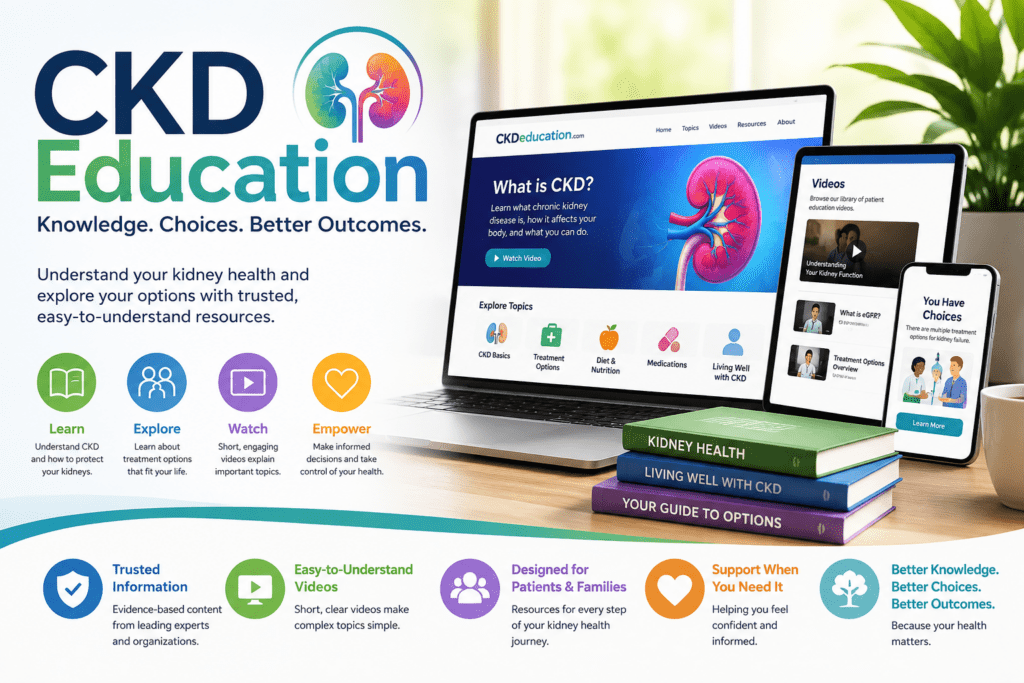
Another resource patients may find very helpful is CKDeducation.com, which uses straightforward explanations and video-based education to make CKD and its treatment options easier to understand.
You can learn about dialysis without choosing dialysis
We recognize that some patients would rather postpone discussions about dialysis.
That is understandable.
But avoiding the conversation does not make the disease go away—and it can sometimes mean that decisions are made later under much more difficult circumstances.
You can learn about dialysis without agreeing to dialysis.
You can learn about peritoneal dialysis without choosing peritoneal dialysis.
You can learn about transplantation without knowing whether you will ultimately be a candidate.
Education is not giving up hope.
Education is preparing for every possibility while continuing to hope for the best.
Kidney education may be covered by Medicare
Many patients are surprised to learn that kidney disease education can be a covered Medicare benefit.
For eligible patients with Stage 4 CKD, Medicare Part B covers up to six sessions of kidney disease education. The program is designed to help patients understand their kidney disease, protect remaining kidney function, and make informed decisions about treatment options such as hemodialysis, peritoneal dialysis, and transplantation.
After meeting the Part B deductible, patients generally pay 20% of the Medicare-approved amount for each session when the service is provided by an eligible provider. Commercial insurance coverage varies by plan.
The power of knowledge
You may never need dialysis.
Your kidney function may remain stable for years.
Treatment may slow the progression of your CKD.
But if your kidney disease does progress, you deserve to understand your options before an emergency forces you to make a decision.
At Connecticut Kidney & Hypertension Specialists, we believe education is an essential part of comprehensive kidney care.
Knowledge doesn’t take away hope.
Knowledge gives you choices.
And when it comes to chronic kidney disease, having choices—and having enough time to make them—can make all the difference.
Take the first step
If you or a family member has advancing CKD, ask your kidney specialist:
“Would kidney disease education be appropriate for me?”
It may be one of the most valuable conversations you have about your kidney health.
Learn More About Our Personalized Kidney Patient Education Program →